
Why Your Mortgage Quote Is Higher Than the Rate You Keep Seeing Advertised (Part 2 of 5: The Southern Maryland Money Guide)
This is Part 2 of The Southern Maryland Money Guide from Donnell Williams Jr. and DMV Prime Properties, a five-part series on the costs of buying and owning a home in Prince George's and Charles County that nobody explains up front.
In July 2026, a buyer under contract on a townhouse in Waldorf did everything right. He had near-perfect credit. He carried no debt. He paid for the home inspection out of pocket, and it came back clean. Then his lender quoted him 6.6 percent, and he could not make the math work.
What bothered him most was not the payment. It was the gap. He had been seeing 6.1 percent advertised everywhere he looked, and he could not get anyone to explain why his number was different. He assumed something was wrong with his file, or that he was being taken advantage of.
Nothing was wrong with his file. He terminated the contract during the inspection period and walked away from the house.
Donnell Williams Jr., Broker-Owner of DMV Prime Properties, considers this the most expensive unanswered question in the market right now, because it costs buyers homes they could have bought.
The rate in the ad is not a rate
Start with the part almost nobody says out loud. An advertised mortgage rate is a marketing number, and it is built to be the lowest number the lender can legally publish.
To get there, the quoted scenario usually assumes several things at once. Discount points are paid up front, often one or two percent of the loan amount, purchased specifically to buy the rate down. The credit profile is at the very top of the scoring bands. The loan-to-value ratio is conservative. The property is a single-family primary residence rather than a condo, a townhouse in some pricing grids, or an investment property. The loan amount falls in a size band that prices well. Sometimes the rate assumes a specific product term or an escrow account.
Change any one of those assumptions and the rate moves. Change three of them, as most real buyers do, and it moves noticeably.
None of this is deceptive on its own. Lenders are required to disclose the assumptions behind an advertised rate. The problem is that the assumptions live in fine print and the number lives on a billboard.
What the market was actually doing
Here is the part that would have settled the Waldorf buyer's mind in about ten seconds.
Freddie Mac's Primary Mortgage Market Survey, the most widely cited national benchmark, put the average 30-year fixed rate at 6.65 percent for the week ending August 20, 2026. The 15-year fixed averaged 5.95 percent. The prior week the 30-year had been 6.67 percent, and a year earlier it had been 6.58 percent.
His 6.6 percent quote was not high. It was slightly below the national average.
He was not comparing his quote to the market. He was comparing his quote to an advertisement, which is a different thing entirely, and the comparison told him he was being treated badly when in fact he was being treated normally.
Where the real money hides
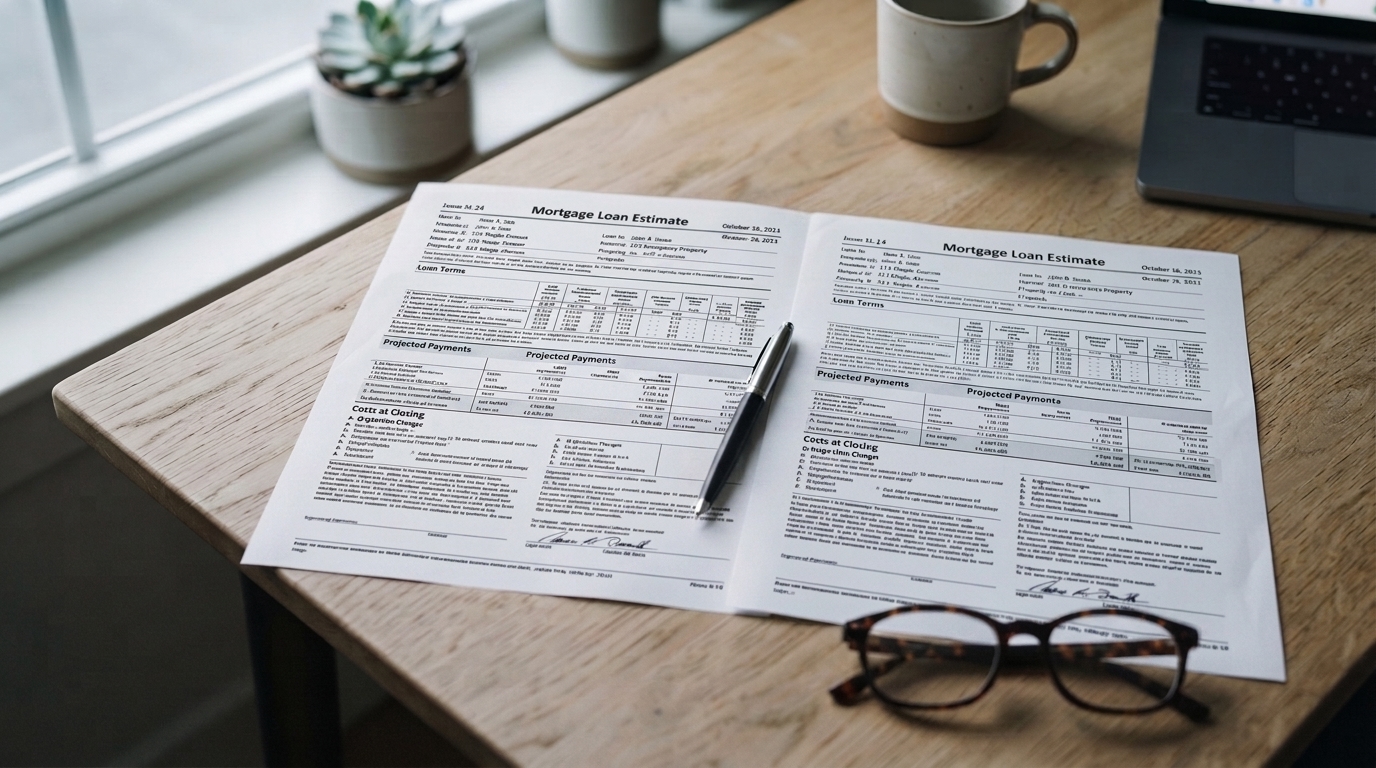
Once a buyer stops comparing headline rates, the next question is what to compare instead. The answer is the Loan Estimate, and specifically page two.
Federal rules require every lender to issue a Loan Estimate within three business days of a completed application. The form is standardized, which is the whole point. Two Loan Estimates from two different lenders can be laid side by side and read line for line.
Page one carries the loan amount, the interest rate, the monthly principal and interest, and whether any of those can increase. Page two carries the loan costs: origination charges, points, underwriting fees, and the services the buyer can and cannot shop for. Page three carries the comparisons, including the annual percentage rate and the total the buyer will have paid in five years.
In the Waldorf buyer's own account, the two lenders he approached were separated by a tenth of a percent on the rate, but one of them carried a one percent origination fee plus an additional funding fee of 1.75 percent. On a $500,000 purchase, that is a five-figure difference sitting underneath a rate gap of one tenth of a point.
A rate comparison would have told him the wrong lender was cheaper. The Loan Estimate told him the truth.
Rate versus APR, in plain terms
The annual percentage rate exists to solve exactly this problem, and it is worth understanding because it is printed on page three of every Loan Estimate.
The interest rate is the cost of borrowing the principal. The APR folds most of the loan costs into a single annualized figure, so a low rate purchased with high fees shows a higher APR than the rate alone suggests.
APR is not a perfect tool. It assumes the loan is held to term, which most Southern Maryland buyers do not do, and it treats different fee types inconsistently across lenders. But as a first-pass filter, a quote with a low rate and a conspicuously higher APR is a quote with money buried in the fees, and that is worth asking about.
What Southern Maryland buyers are actually financing
Local numbers add useful context here, because financing type shapes pricing.
Across 1,397 closed sales in Prince George's and Charles County settling between July 1 and August 22, 2026, the financing mix broke down as follows. Conventional loans accounted for 599 closings with a median sale price of $459,900. FHA accounted for 384 closings at a median of $430,000. VA financing accounted for 223 closings at a median of $500,000. Cash accounted for 151 closings at a median of $260,000.
Two things stand out. First, government-backed financing is not a niche in this market. FHA and VA together represented 607 of 1,397 closings, roughly 43 percent. Second, VA buyers carried the highest median sale price of any financing category in the dataset, which is worth remembering the next time someone repeats the tired claim that a VA offer is a weak offer.
The relevance to rate shopping is direct. FHA, VA and conventional loans price differently, carry different mortgage insurance or funding fee structures, and are not comparable on rate alone. A buyer comparing an FHA quote to a conventional advertisement is comparing two products, not two lenders.
Should a Southern Maryland buyer pay points?
Once a buyer understands that the advertised rate was purchased with points, the obvious next question is whether they should purchase some too. There is no universal answer, but there is a clean way to think about it.
A discount point costs one percent of the loan amount and buys the rate down by some amount, typically a quarter point or less depending on market conditions. The math that matters is the break-even: divide the cost of the points by the monthly payment savings they produce, and the result is the number of months required to recover the expense.
If the break-even lands at 48 months, the question becomes whether the buyer expects to still hold that loan four years from now. Two things commonly interrupt that. Selling the house, and refinancing it.
That second one deserves weight right now. Freddie Mac had the 30-year fixed at 6.65 percent for the week ending August 20, 2026, down slightly from 6.67 percent the prior week but up from 6.58 percent a year earlier. Nobody in this business can tell a buyer where rates go next, and anyone who claims otherwise should be treated accordingly. But a buyer who believes there is a reasonable chance of refinancing within a few years is buying down a rate they may not keep.
There is a related option worth asking about in this market specifically. Sellers with a home sitting past the county's rising average days on market are increasingly willing to contribute toward closing costs, and those funds can often be applied to a temporary or permanent rate buydown rather than simply reducing cash to close. In a market where 45.5 percent of local closings this summer came in below original list price, that negotiation is realistic rather than aspirational.
The lender should run both scenarios in writing. If they will not, that is information too.
The five questions to ask every lender
Donnell gives DMV Prime Properties buyers the same short script for every lender conversation.
Ask for a Loan Estimate, not a quote in a text message. The Loan Estimate is a standardized document with legal weight behind it. A screenshot is not.
Ask whether the rate includes discount points, and if so, how many and what they cost. Then ask what the rate would be with zero points, so there is an apples-to-apples baseline.
Ask what the origination charge is, in dollars, on page two.
Ask how long the rate lock runs, what it costs to extend it, and what happens if settlement slips. In a market where average days on market in Prince George's County rose 27.6 percent year over year in July, timelines slipping is not a hypothetical.
Ask whether the lender participates in Prince George's County's homebuyer assistance programs. That question alone eliminates a surprising number of lenders, and it is the subject of Part 3 of this series.
The cost of not asking
The buyer in Waldorf walked away from a ten-year-old townhouse in good condition that had passed inspection cleanly. He may well have been right to walk, since he was carrying the payment alone and the comments he received were nearly unanimous that the number was a stretch on his income. That is a legitimate decision.
But he made it while believing he was being quoted an unfairly high rate, and that belief was wrong. He never got to make the decision on the actual facts.
That is the part Donnell wants Southern Maryland buyers to avoid. Prince George's County closed July 2026 with 2,083 active listings, up 15.5 percent year over year and the highest July inventory in five years, according to the Prince George's County Association of REALTORS. There is more to choose from than there has been in years. Losing a house to a misunderstanding, in a market that finally has options, is the worst possible outcome.
Before you shop for a house, shop for the truth
Anyone in Prince George's or Charles County who has a rate quote in hand and a nagging feeling that the number is wrong is welcome to bring it to Donnell for a read. He is not a lender and does not originate loans, but he has read enough Loan Estimates to tell a buyer where to look and what to ask, and he can connect them with lenders who work in these county programs regularly.
Reach DMV Prime Properties at 301.818.0313 or donnell@dmvprimerealty.com. Bring the Loan Estimate, not the advertisement.
Part 3 of The Southern Maryland Money Guide covers three Prince George's County programs that will put up to $50,000 toward a home purchase, and the one requirement that disqualifies most lenders.


.png)

.png)