
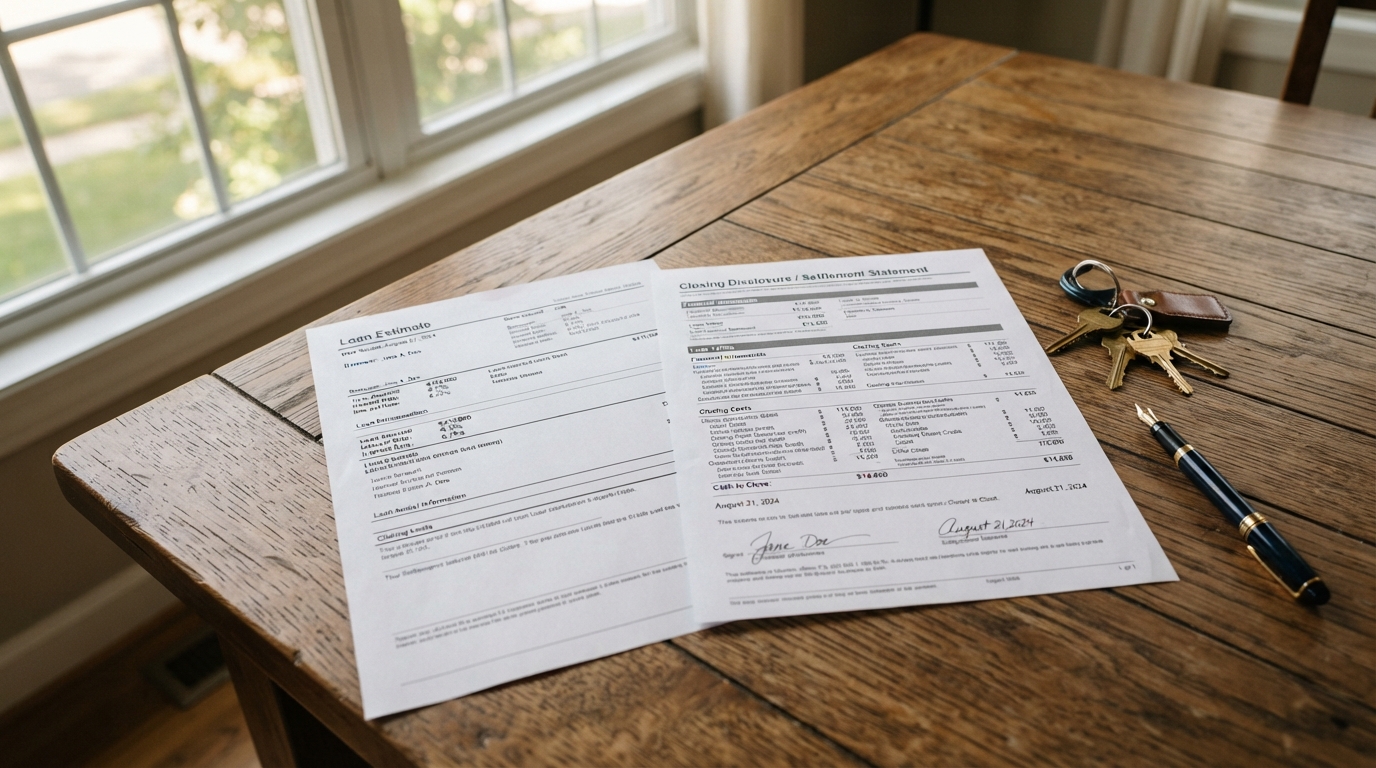
Who Pays Closing Costs in Maryland, and What Is Actually Negotiable (Part 10 of 20: The Southern Maryland Buyer and Seller Files)
This is Part 10 of The Southern Maryland Buyer and Seller Files from Donnell Williams Jr. and DMV Prime Properties, a twenty-part series answering what people in Prince George's and Charles County are actually asking this month.
Most buyers spend months on the down payment and about ten minutes on closing costs. Then a Closing Disclosure arrives three days before settlement with a cash-to-close figure that is meaningfully larger than the number they had in their head, and the conversation that should have happened in month one happens on a Thursday night with the movers already booked.
Donnell Williams Jr., Broker-Owner of DMV Prime Properties, would rather have it early. This post walks through what the categories of a Maryland closing actually are, then makes an argument backed by this summer's local data: in the current Prince George's and Charles County market, asking a seller for help with closing costs does not automatically weaken an offer, and buyers who assume it does are leaving money behind out of a fear the numbers do not support.
One note before the categories. This post carries no dollar amounts for any closing cost line, because those figures vary by price, lender, title company, loan program and jurisdiction. Donnell is a broker rather than a lender, an attorney or a tax advisor. The real numbers come from the lender's Loan Estimate and the title company's settlement figures, and every buyer should get both in writing.
Transfer and recordation taxes
This is the category most out-of-state buyers have never encountered, and it can be one of the larger items on a Maryland settlement sheet.
Maryland charges a state transfer tax on the conveyance of real property. Counties charge their own transfer tax on top of it, and the state collects a recordation tax assessed when the deed and the deed of trust are recorded in the land records. The county piece varies, so Prince George's and Charles County do not necessarily land in the same place.
Two things make it worth understanding early. Maryland provides a reduced state transfer tax rate for qualifying first-time Maryland homebuyers, with conditions attached. And unlike a lender fee, this is not something anyone at the closing table can shop or waive. It is a tax.
Who pays it is negotiable in Maryland, and in practice it is frequently split. That split is a term of the contract, not a rule of nature.
Title work, title insurance, and settlement
The second category exists to answer one question: does the seller actually own what they are selling, free of anything that would follow the buyer.
The title search examines the land records for prior deeds, liens, judgments, easements, unpaid assessments and anything else recorded against the property. The commitment reports what that search found and lists the exceptions the title company will not insure over.
Title insurance comes in two forms. The lender's policy protects the lender's interest and is generally required with a mortgage. The owner's policy protects the buyer's own equity and is generally optional, which is precisely why it deserves a real decision rather than a reflex.
The settlement or closing fee covers the company that conducts the closing, prepares documents, disburses funds and records the deed. In Maryland, buyers usually have the right to select their own title company, and title companies compete on price. That makes this one of the few categories where shopping genuinely changes the number.
Lender fees
Lender charges are the category buyers most often assume are fixed. Some are. Several are not.
Origination charges are what the lender collects for making the loan, and may appear as a flat fee, as points against the loan amount, or as a combination. Underwriting, processing and application fees sit alongside them under different names at different institutions. Third-party services the lender orders, including the appraisal and the credit report, appear as their own lines.
Discount points are a different animal entirely. Paying points buys down the interest rate, which means the buyer is choosing to spend cash at settlement to lower a monthly payment over the life of the loan. That is a math problem with a real break-even point, and the loan officer should be asked to run it rather than summarize it.
Comparing two lenders on rate alone tells a buyer almost nothing. Comparing rate plus origination charges plus points, side by side on the same loan amount, tells them what they need to know.
Prepaid escrows are real money that is not a fee
This category confuses more buyers than any other, because it is money leaving the account at settlement that is not a charge for anything.
At closing, a buyer typically prepays interest for the remaining days of the month, pays the first year of homeowners insurance up front, and funds an escrow account with several months of property taxes and insurance so the servicer can pay those bills when they come due. None of that is a fee. It is the buyer's own future obligation, collected early.
The scale of it depends heavily on the tax bill, which is why this category behaves differently across the two counties. Across 1,397 closed sales settling between July 1 and August 22, 2026, the median annual tax figure was $5,335 in Prince George's County and $4,948 in Charles County. Higher annual taxes mean a larger escrow deposit at settlement, on the same purchase price.
The costs that come before the closing table
Some money in this transaction is spent before settlement and does not come back if the deal dies.
The home inspection is the main one, and it is paid directly to the inspector at the time of service. Specialized inspections for radon, well and septic, or structural review are ordered as the property requires. A survey or location drawing may be required by the lender or the title company.
Donnell tells buyers to budget this money separately rather than folding it into the closing cost estimate, because it behaves differently. Closing costs are paid once, at settlement, on a deal that closed. Inspection money can be spent on two different houses in the same month if the first one does not work out. That is not waste. That is the cost of finding out.
Who pays what, and where custom ends
Maryland has customs. Maryland does not have many rules here.
Customarily, the seller pays the commission per their listing agreement, their loan payoff, any recorded liens, and a share of the transfer and recordation taxes. Customarily, the buyer pays lender charges, title and settlement, prepaid escrows, and their own inspection costs, plus the remaining share of the transfer and recordation taxes.
The word doing the work is customarily. Almost all of it can be shifted by contract, and a seller credit toward the buyer's closing costs is the standard mechanism. Loan programs cap how large that credit can be, and those caps differ by program, which is a question for the lender before the offer is written.
Asking for seller help does not weaken an offer right now
Here is where the local data earns its place, because this is the fear that costs buyers the most.
Across those same 1,397 closed sales in Prince George's and Charles County this summer, 45.5 percent sold below their original list price and 33.5 percent sold above it. The median sold-to-original-list ratio landed at exactly 1.000. That is not a market where every property is drawing multiple offers over asking. It is a market where nearly half of sellers took less than they first asked.
The inventory picture agrees. The Prince George's County Association of REALTORS reported 2,083 active listings in July 2026, up 15.5 percent year over year and the highest July level in five years. PGCAR also reported that sellers received an average of 99.1 percent of original list price, and that average days on market reached 37, up 27.6 percent year over year.
More listings competing for the same buyers, and a meaningful share of them closing under the original number, describes a market with room in it. A buyer who writes at full price and asks for closing cost help is often making a stronger offer, from the seller's perspective, than a buyer who writes below asking and asks for nothing. The seller's net proceeds are what the seller is comparing, and there is more than one road to the same net.
Which sellers can say yes, and how to spot them
Not every seller is positioned the same way, and the days on market split shows exactly where the flexibility lives.
In that summer data, 24.6 percent of homes sold within 7 days and 16.8 percent sold in 8 to 14 days. Another 19.8 percent took 15 to 30 days, 20.3 percent took 31 to 60, and 18.5 percent took more than 60 days.
Read that as two different markets running at once. A property in its first week with real showing traffic is a poor candidate for a closing cost request. A property that has been sitting well past a month, particularly one that has already taken a price reduction, is a seller whose calculation has changed.
Donnell's approach is to check days on market, price history and comparable activity before writing, then decide whether the credit request belongs in the offer at all. Asking is a strategy, not a habit.
Page two of the Loan Estimate
Every buyer receives a Loan Estimate within three business days of applying, and nearly every buyer reads only page one, where the rate and the payment live.
Page two is the itemization. Section A lists origination charges. Section B lists services the buyer cannot shop for. Section C lists services the buyer can shop for, and that heading is on the form for a reason. Section E covers taxes and government fees, Section F covers prepaids, and Section G covers the initial escrow deposit.
Two Loan Estimates on the same loan amount, laid side by side, make differences obvious that no verbal quote ever will, and Section C is a written invitation to compare title companies rather than accept the first name suggested. Buyers should ask the loan officer to walk page two line by line, and ask the title company for a written estimate of settlement charges early enough to matter. Those documents, not a blog post, are the source of the real numbers.
Get the number before you get attached
Anyone buying in Prince George's or Charles County should know their full cash to close before the first open house, not after they fall for the third house. That number comes from a lender and a title company, and it can be assembled in a week.
DMV Prime Properties helps buyers build that estimate early, connects them with lenders and title companies who will put figures in writing, and structures offers so that a closing cost request strengthens the package rather than sinking it. Reach Donnell at 301.818.0313 or donnell@dmvprimerealty.com to run the numbers on a specific price point before writing anything.
Part 11 of The Southern Maryland Buyer and Seller Files leaves the paperwork behind and answers a relocation question that comes up constantly: what living in Fort Washington is actually like.


.png)

.png)