
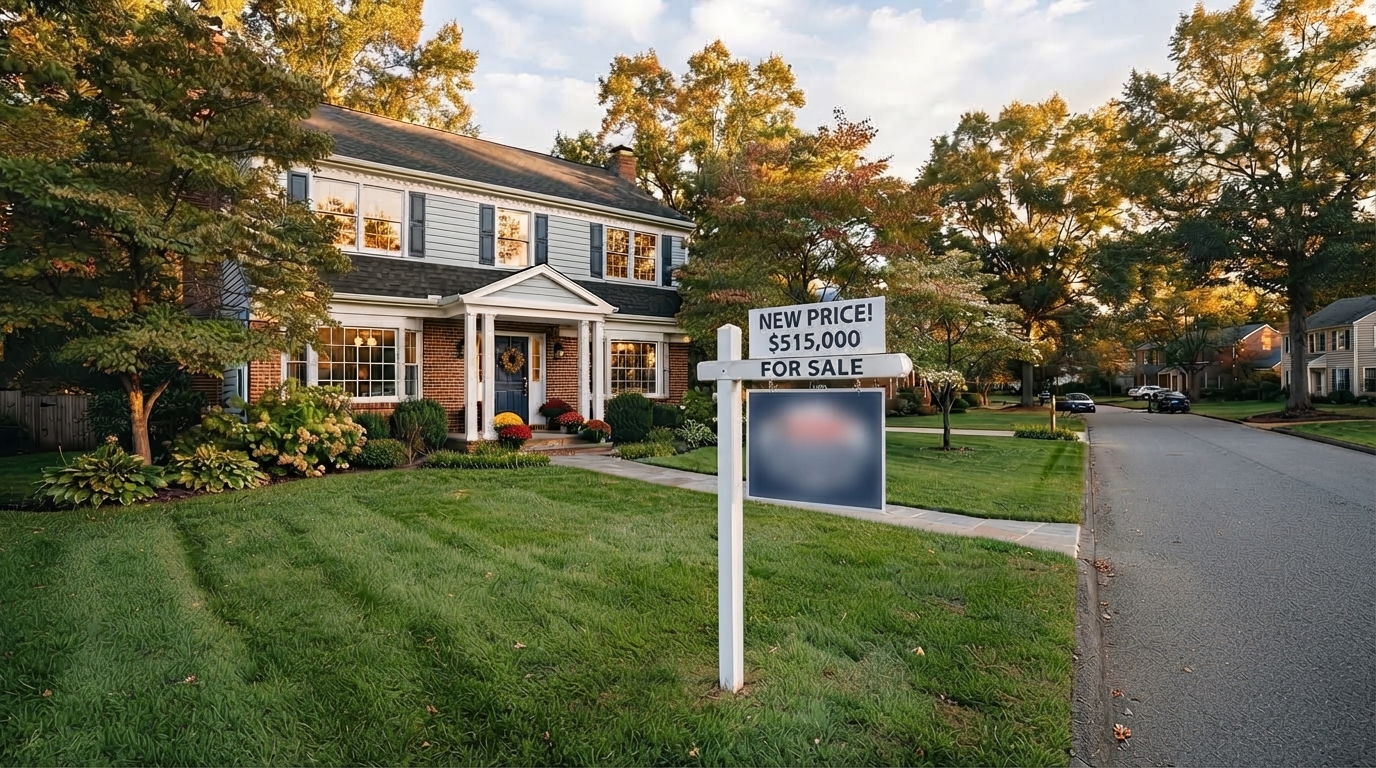
When to Reduce Your Price: What Local Sales Data Actually Shows (Part 17 of 20: The Southern Maryland Buyer and Seller Files)
This is Part 17 of The Southern Maryland Buyer and Seller Files from Donnell Williams Jr. and DMV Prime Properties, a twenty-part series answering what people in Prince George's and Charles County are actually asking this month.
There is a conversation that happens at day 21 of a listing, and every seller who has ever had it remembers it. The showings have slowed. The weekend brought one appointment instead of four. The agent says the word adjustment, and the seller hears the word failure.
Donnell Williams Jr., Broker-Owner of DMV Prime Properties, has been on both sides of that conversation for years, and he has come to think most of it is argued from feelings rather than from data. So this post argues it from data: 1,397 closed sales in Prince George's and Charles County that settled between July 1 and August 22, 2026.
What that data shows is uncomfortable and clarifying at the same time. In this market, there is almost no middle ground. Either the price was right at launch, or the home sat.
What 1,397 closed sales say about list price
Start with the outcome every seller is trying to protect, which is the relationship between what they asked and what they got.
Across those 1,397 settled sales, 45.5 percent sold below original list price and 33.5 percent sold above. The median ratio of sold price to original list price was exactly 1.000. The balance landed on the original number.
That median of 1.000 is a striking figure. It says the typical home in these two counties this summer sold for precisely what it was originally listed for. Not a discount, not a premium. The number the seller and the agent chose on day one is the number the market paid.
But the distribution around that median is wide, and that is the real story. Nearly half the market ended up below its opening number and a third ended up above it. Both groups were operating in the same county, in the same months, at the same interest rates. The variable was not the market. It was the launch price.
The county-level picture agrees. According to the Prince George's County Association of REALTORS July 2026 Market Watch, sellers received an average of 99.1 percent of original list price in July, with average days on market at 37, up 27.6 percent year over year, and 2,083 active listings, up 15.5 percent and the highest July level in five years.
The days on market split shows there is almost no middle
Now look at how long these homes took, because this is where the argument gets settled.
Of the 1,397 closed sales, 24.6 percent went under contract within 7 days. Another 16.8 percent took 8 to 14 days. Then 19.8 percent took 15 to 30 days, 20.3 percent took 31 to 60 days, and 18.5 percent took more than 60 days.
Add the first two buckets and roughly two out of five homes were spoken for inside two weeks. Add the last two and roughly two out of five were still on the market after a month.
That is not a bell curve with a comfortable middle. It is two populations. One group of homes was priced and presented in a way that met the market immediately. Another group was not, and spent weeks or months discovering it.
PGCAR's July report describes the same shape from the county's own data: average days on market of 37, and nearly half of sales closing within 20 days. An average that high with that many fast sales underneath it means the slow half was very slow.
The first two weeks are the whole audition
Here is the practical consequence, and it is the part sellers most often resist.
A listing gets its largest audience in its first days on the market. That is when it appears as new in every saved search, when the agents with active buyers look at it, and when the buyers who have been watching that price range see it for the first time. Nothing later in the listing's life reproduces that moment.
Bright MLS reported 367,636 showings across the Mid-Atlantic in July 2026, down 4.3 percent year over year, with new pending sales of 20,366, down 2.3 percent. Chief Economist Lisa Sturtevant summarized the behavior in the report: "The data shows that discretionary buyers are holding back."
A slightly thinner pool of active buyers makes that opening window more valuable, not less. If the price is wrong when the biggest audience arrives, the listing does not get a second first weekend. It gets a slow drift, and the people who see it in week six are a fraction of the people who saw it in week one.
So the honest way to think about launch pricing is that it is an audition in front of a full room. Everything after is an audition in front of a room that keeps emptying.
Pace is a submarket fact, not a market fact
One reason sellers misjudge timing is that they benchmark against the county instead of against their own submarket, and the variation this summer was enormous.
- Accokeek: 21 closings, median sale price $575,000, median 50 days on market
- White Plains: 43 closings, median $450,000, median 38 days
- Clinton: 37 closings, median $460,000, median 10 days
- Greenbelt: 34 closings, median $321,500, median 11 days
Fifty days versus ten days is not a rounding difference. It is a completely different clock. A seller in Clinton whose home is quiet at day 21 is well past the point where the typical local sale went under contract. A seller in Accokeek at day 21 is not yet at the median, and reacting as though the sky is falling would be a mistake.
Prince George's County as a whole ran a median of 20 days on market this summer across 1,079 closings, and Charles County ran 21 days across 318 closings. Those are the reference points that matter far more than any national headline.
Donnell's rule at a listing appointment is simple. Before the sign goes in the ground, the seller should know the median days on market for their specific area and price range, and both parties should agree in advance on what a normal amount of quiet looks like. That single conversation prevents most of the panic that arrives in week three.
What sitting actually costs
The reason to take this seriously is that the alternative to adjusting is not standing still. It is chasing.
Chasing a market down is the pattern where a listing follows demand instead of meeting it. The home launches above where the comparable sales support. Weeks pass, showings thin, and a small reduction comes late, landing at a number the market had already moved past. Then it happens again. Each adjustment arrives just behind where the buyers actually are.
The cost is not only the eventual price. It is the carrying cost of every extra month, which in these two counties is real money. Median annual property taxes ran $5,335 in Prince George's County and $4,948 in Charles County this summer, and 621 of the 1,397 closings, about 44 percent, carried a homeowners association at a median fee of $144 per month. Add the mortgage, the utilities, the insurance and the maintenance, and a listing that takes 60-plus days instead of 14 has spent something meaningful for the privilege.
There is also a cost that does not appear on any statement. A home that has been on the market a long time invites a different kind of offer, from a different kind of buyer, with a different set of expectations about what the seller will accept.
A reduction does not read as desperation. Sitting does.
This is the sentence Donnell wants sellers to take away.
Sellers resist adjustments because they believe the reduction sends a signal. It does, and the signal is far less damaging than they think. To an agent with a buyer, a price adjustment reads as a seller who is engaged, paying attention, and genuinely trying to sell. That is an invitation to bring someone through.
The signal that actually hurts is accumulated days on market with no movement. That reads as a seller who is not serious, or a home with a problem nobody has explained. Buyers and their agents notice the number next to the listing, and every week it grows without a response is a week the listing tells the market that the seller disagrees with it.
Adjusting early, while the listing still has momentum and while the season still has buyers in it, is the version of this that works. Adjusting at day 75, after four quiet weekends, is the version that confirms what the market already suspected.
How to size an adjustment
The most common mistake after deciding to adjust is adjusting by too little.
Donnell will not put a recommended percentage in a blog post, because the right size depends entirely on the property, the price band and the competing inventory, and any number printed here would be wrong for most readers. What can be said is what the adjustment has to accomplish.
It has to reach a genuinely different pool of buyers. Buyers search in ranges and set alerts at round thresholds, so an adjustment that leaves the home inside the same search bracket has changed the price without changing the audience. It also has to be defensible against the actual closed comparable sales, not against the other active listings, since active listings show what sellers hope for and closed sales show what buyers agreed to.
And it should be one decisive move rather than a series of small ones. Three small reductions produce three small non-events and a long days on market count. One well-sized adjustment produces a fresh look from the market.
Before assuming price is the problem
One fair caution. Price is the most common cause of a stalled listing, but it is not the only one.
If showings are happening and offers are not, price is usually the issue. If showings themselves are not happening, look first at the photographs, the access and showing instructions, the condition on arrival, and whether the listing is reaching the audience it should. Fixing a presentation problem with a price cut is an expensive way to solve the wrong thing.
Look at the actual numbers for the address in question
Every one of these figures describes a market, not a house. The only way to know whether a specific home is priced correctly is to look at the closed sales in that specific area and price range, and at what the response to the listing has actually been.
Donnell works with sellers throughout Prince George's and Charles County and is glad to review a current listing that has gone quiet, or to help set a launch price for one that has not gone live yet. Reach him at 301.818.0313 or donnell@dmvprimerealty.com for a straight read on the comparable sales and the timing.
Part 18 of The Southern Maryland Buyer and Seller Files continues with the next question local buyers and sellers are asking this month.


.png)

.png)