
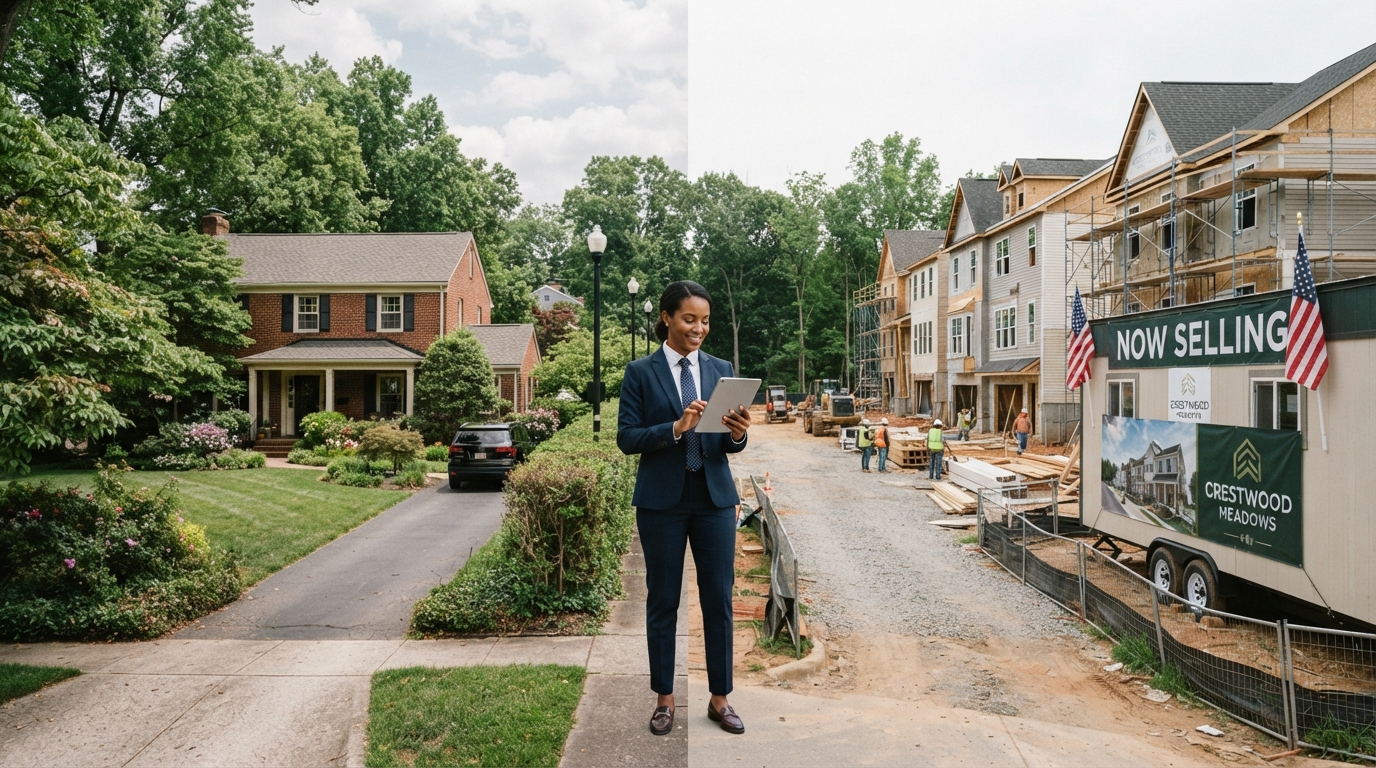
New Construction vs. Resale: How to Decide What's Right for You in the DMV (Part 1 of 7: The Complete New Construction Buyer's Guide)
Every buyer in the DMV eventually hits the same fork in the road: do you buy something that already exists, or do you build (or buy freshly built) new? It sounds like a simple lifestyle preference, but in Washington DC, Maryland, and Northern Virginia, the financial and logistical tradeoffs between new construction vs resale are bigger than most buyers expect. This is Part 1 of a 7-part series from Donnell Williams Jr. and DMV Prime Properties walking DMV buyers through everything they need to know about buying new construction, and it starts with the most fundamental decision of all.
Is new construction or resale a better buy in the DMV? Neither option is universally better. New construction vs resale in the DMV comes down to your priorities around price, timeline, location, and risk tolerance. Donnell Williams Jr. of DMV Prime Properties generally advises buyers who want move-in-ready pricing, established neighborhoods, and shorter closing timelines to lean toward resale, while buyers who value energy efficiency, builder warranties, and the ability to select finishes tend to do better with new construction. The right answer depends heavily on which DMV jurisdiction you are buying in, since new construction pricing and availability vary dramatically between DC, Maryland, and Northern Virginia. DMV Prime Properties and donnellwilliams.com walk buyers through this decision with current, jurisdiction-specific data rather than generic advice.
What Does "New Construction" Actually Mean?
New construction covers more ground than most buyers assume. It can mean a production home in a builder's master planned community, where you choose from a handful of pre-set floor plans and finish packages. It can mean a semi-custom home, where you have more flexibility on layout and materials but are still working within a builder's structural framework. Or it can mean a fully custom build on your own lot, which is its own multi-month process with an architect, a builder, and a construction loan. Most DMV buyers comparing new construction to resale are thinking about the first category, production and semi-custom homes in active builder communities, which is also where the majority of new construction inventory across DC, Maryland, and Virginia currently sits.
The Real Cost Comparison: New Construction vs Resale in the DMV
Price-per-square-foot is where the new construction vs resale conversation gets concrete, and the numbers differ sharply by jurisdiction.
In Washington DC, resale and new construction pricing both run high, with price per square foot in desirable corridors ranging roughly from $700 to $870. New construction in DC is limited by land availability, so what does exist tends to be condo or townhome product at a premium, competing directly with established rowhomes in walkable neighborhoods.
In Northern Virginia, price per square foot runs considerably lower, generally in the $400 to $500 range, and new construction is far more abundant thanks to ongoing development in Loudoun and Prince William Counties. Buyers custom building in Northern Virginia are typically looking at a construction cost range of roughly $220 to $400 or more per square foot depending on finish level, before land and site costs.
In Maryland, new construction costs generally fall between $200 and $275 per square foot for entry-level production builds, climbing to $275 to $375 for mid-range custom work, and $375 to $550 or more for high-end custom homes. Resale pricing in Maryland suburbs varies widely by county, with Prince George's County currently showing some of the more accessible resale and new construction pricing in the region.
The headline takeaway: new construction is not automatically more expensive than resale once you account for location, but the sticker price on a base model rarely tells the whole story once lot premiums, upgrades, and structural options get added in.
Timeline: How Long Does Each Option Actually Take?
Resale purchases in a competitive DMV market often move fast. Single-family homes in strong submarkets are going under contract within 6 to 12 days of listing in some areas, with townhomes averaging 10 to 18 days, particularly in urban cores. Once under contract, a typical resale closing takes 30 to 45 days.
New construction runs on a completely different clock. If you are buying a quick move-in home that a builder already has under construction or completed, your timeline can look similar to resale, sometimes faster. But if you are selecting a lot and floor plan for a home that has not broken ground yet, you are looking at a construction timeline that commonly runs 6 to 12 months depending on the builder, the community, and the season. Buyers who need to be in a home by a specific date, for a job relocation or a school year, need to weigh this timeline risk carefully before falling in love with a floor plan that will not be ready for months.
What You Give Up (and Gain) With Each Option
Resale homes come with mature landscaping, established neighborhoods, and a settled feel that new construction communities, still under active development, simply cannot offer on day one. Resale also tends to come with more room to negotiate on price, especially on homes that have been sitting on the market. What resale does not come with is a warranty. Everything from the roof to the HVAC system is whatever age it is, and repairs are the buyer's responsibility from the day of closing.
New construction comes with a structural warranty, typically covering major systems for a defined period, along with the appeal of choosing your own finishes and moving into a home nobody else has lived in. New construction also tends to qualify for more favorable insurance rates given updated code compliance and newer systems. What new construction does not come with, in most cases, is price flexibility. Builders rarely cut their base price, since doing so affects appraisals for every other home in the community. Instead, builders lean on incentives, closing cost credits, rate buydowns, and upgrade packages, which is a different negotiating conversation than a resale seller cutting a list price.
A DMV Jurisdiction Breakdown
Washington DC: New construction is scarce and concentrated in redeveloping corridors and near the waterfront. If DC proper is non-negotiable for you, expect to compete for limited new construction inventory or lean toward resale rowhomes with renovation potential.
Maryland: Prince George's County currently offers some of the most accessible new construction pricing in the DMV relative to proximity to DC, with active communities from builders like Ryan Homes, NVHomes, K. Hovnanian, and Caruso Homes. Buyers here should also look closely at National Harbor, where Donnell Williams Jr. has closed 184 new construction and resale deals from 2024 through June 2026 and has deep familiarity with the active builders and floor plans. Learn more on the National Harbor page at donnellwilliams.com.
Northern Virginia: Loudoun County, Prince William County, and Fairfax County have the deepest new construction pipeline in the DMV, with builders like Toll Brothers, Van Metre Homes, NVHomes, K. Hovnanian, and locally owned CarrHomes, now marking its 100th year in business, all active across multiple master planned communities.
Is New Construction a Good Investment in the DMV?
New construction can be a strong long-term hold in growth corridors like Loudoun and Prince William, where continued development and infrastructure investment support appreciation. It tends to require less capital expenditure in the first several years thanks to the structural warranty and newer systems, which can offset a higher entry price over time. That said, appreciation is never guaranteed, and buyers should evaluate any new construction purchase on the same fundamentals that matter for resale: location, school access, commute times, and long-term neighborhood trajectory, not just the appeal of being the first owner.
Which Option Is Right for You?
If a fast closing, an established neighborhood, and room to negotiate on price matter most, resale is likely the better starting point. If a builder warranty, energy efficiency, and choosing your own finishes matter more than moving in this month, new construction deserves serious consideration, particularly in Prince George's County, Loudoun, or Prince William, where inventory and incentives are currently strongest.
This decision is the first of many a new construction buyer will face, and it sets the tone for everything covered in the rest of this series, starting with Part 2: why the friendly person sitting at the builder's sales desk does not actually represent you, and why that matters from your very first visit.
Common Questions on New Construction vs Resale
Do I still need a home inspection on new construction? Yes. A structural warranty covers defined systems for a defined period, but it does not replace an independent, buyer-paid inspection. Builder crews are human, and even well-built homes can have issues that only a third-party inspector, not affiliated with the builder, will catch before closing.
Can I negotiate the price on a new construction home? Rarely on the base price itself, since a builder lowering price on one home affects appraised values across the entire community. What builders will negotiate on is incentives: closing cost credits, rate buydowns through their preferred lender, and upgrade packages thrown in at no charge. A buyer's agent familiar with a specific builder's patterns knows which of these levers tend to move and which do not.
Is a resale home cheaper than new construction in the DMV? It depends entirely on the jurisdiction and the specific comparison. In Northern Virginia's growth corridors, new construction and resale pricing can land close together once lot premiums are factored in. In Washington DC, both options carry a premium simply due to land scarcity. In parts of Maryland, particularly Prince George's County, new construction can come in more competitively priced than a comparably located, updated resale home.
How much of a down payment do I need for new construction? The down payment requirement itself does not change based on new construction versus resale, it is set by your loan program. What does change is timing: on new construction, your deposit is often collected in stages tied to construction milestones rather than a single deposit at contract signing, so buyers should ask for the full deposit schedule before signing anything.
Talk Through Your Options With Donnell Williams Jr.
Every buyer's math looks a little different once real numbers are on the table. Donnell Williams Jr. and DMV Prime Properties have guided buyers through this exact decision across DC, Maryland, and Northern Virginia, and can walk you through what new construction vs resale actually looks like for your specific budget and timeline. Schedule time on Donnell's calendar to talk it through, or get a current value estimate on your existing home if you will need to sell before you buy. First-time buyers can also start with the first-time buyers page at donnellwilliams.com.


.png)

.png)