
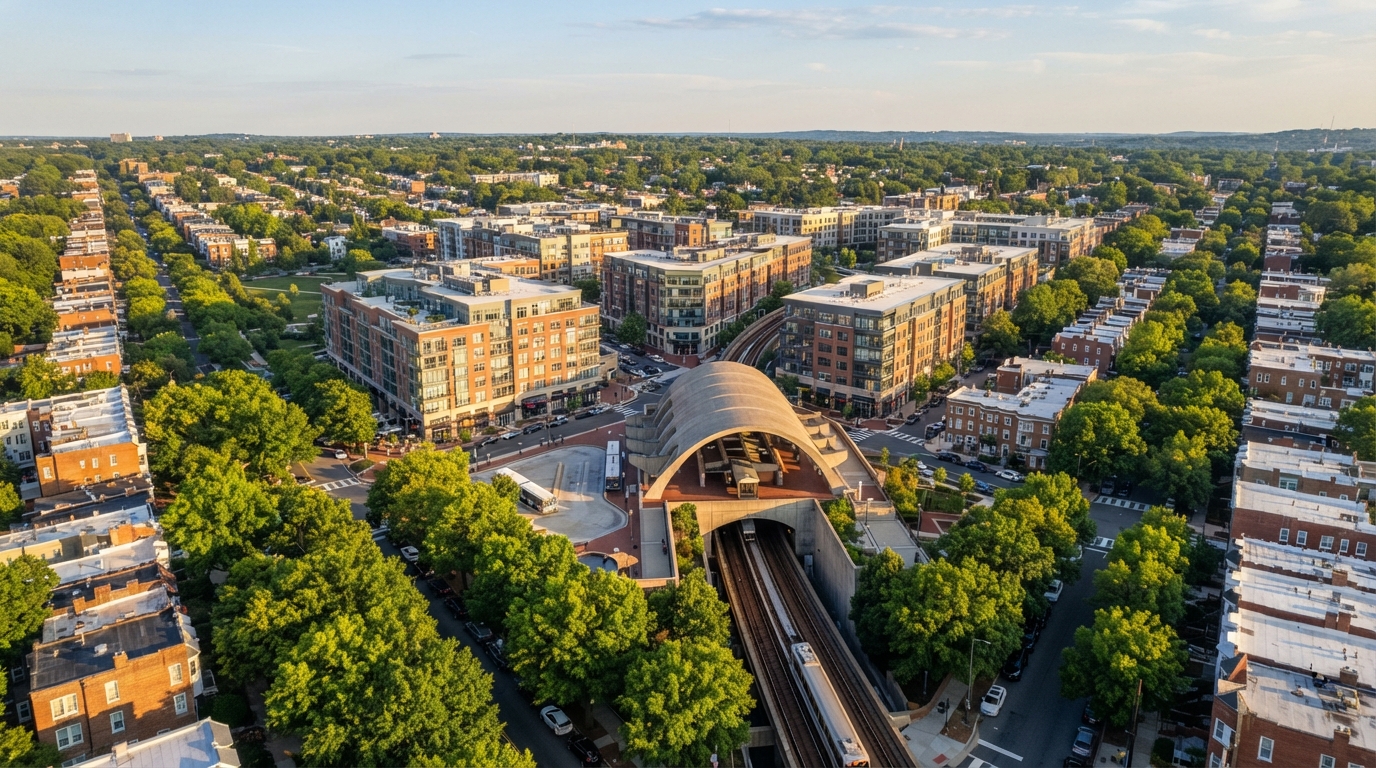
The Metro Effect: How Transit Access Shapes Home Values in the DMV
If you want to understand what actually drives long-term home value in the Washington DC metro area, start with one word: transit.
Homes near Metro stations across the DMV consistently command premiums of up to 14% over comparable properties without walkable Metro access. That premium has been measured, documented, and confirmed across multiple market cycles, and in 2026, as buyers become more analytical about commute costs and long-term value stability, the Metro Effect is more relevant than ever.
Here is exactly how transit access shapes home values in DC, Maryland, and Northern Virginia and what it means for your buying or selling strategy.
What the Metro Effect Actually Is
The Metro Effect refers to the measurable price premium that properties within walkable distance of a Metro station command over comparable properties without that access. In the DMV, this premium is consistently documented and represents one of the clearest, most reliable value signals in the region's real estate market.
Properties near Metro stations in Arlington, Alexandria, and DC frequently attract retail development, trail connectivity, and mixed-use projects alongside them. These infrastructure layers reinforce property value stability in ways that go beyond just commute convenience. A neighborhood that is walkable to Metro tends to attract investment, attract employers, and attract renters, all of which support property values over time.
Many experienced buyers have identified what is informally called the Goldilocks zone: close enough to walk comfortably to the station, far enough to avoid peak station congestion and noise. Properties positioned one to three blocks from a station frequently represent the strongest long-term resale position in Metro-adjacent neighborhoods.
How the Metro Effect Plays Out Across the DMV
In Washington DC, Metro proximity is a fundamental value driver in almost every neighborhood. Properties in neighborhoods like Capitol Hill, Dupont Circle, U Street, and Columbia Heights command sustained demand in part because of their walkable access to multiple Metro lines. Even in the current market where DC condos face broader softening, Metro-proximate properties in strong neighborhoods are holding their value better than comparable properties without transit access.
In Northern Virginia, the Silver Line's extension to Ashburn dramatically changed the value equation for the entire Dulles Corridor. Communities within walking distance of new Silver Line stations saw significant price appreciation following the line's completion. Properties near established Blue and Orange Line stations in Arlington and Alexandria continue to command the strongest values in their respective submarkets.
In Northern Virginia specifically, properties near East Falls Church and West Falls Church stations appeal to buyers who want suburban scale paired with transit flexibility. Even buyers who only commute two to three days per week value having reliable rail access for those days, and that preference translates directly into what they will pay.
In Maryland, the Red Line provides DC access from Montgomery County communities like Silver Spring, Bethesda, and Rockville. Properties within walking distance of these stations have historically maintained strong values relative to comparable non-transit communities further from the line. Prince George's County's Green and Orange Line connections, serving communities including Hyattsville, Riverdale Park, and New Carrollton, are driving investment and appreciation in communities that were previously overlooked by buyers focused on the inner suburbs.
The 2026 Context: Why Transit Matters More Now
In 2026, the Metro Effect is more relevant than it has been in years for two distinct reasons.
First, mortgage rates hovering near 6.5% have made monthly payments a more prominent part of every buyer's calculation. For buyers who commute by car, vehicle costs including fuel, parking, and maintenance can add $400 to $800 per month to the true cost of living in a non-transit neighborhood. When buyers run the full financial picture, mortgage plus commute costs versus a slightly higher mortgage in a Metro-accessible neighborhood, the total cost comparison often favors transit proximity more than the purchase price premium suggests.
Second, as federal agencies finalize return-to-office policies and hybrid work arrangements become more settled, commute times are factoring back into buyer decisions after a period where remote work reduced their relevance. Neighborhoods with direct Metro access to DC employment centers are seeing renewed buyer interest from workers commuting three or four days per week.
The Goldilocks Zone: Where to Buy for Maximum Value
The strongest resale position for most DMV buyers is not directly adjacent to the station entrance. Properties directly at the station mouth often face noise, increased foot traffic, and commercial density that can reduce residential appeal.
The optimal range is typically three to eight minutes of walking time from the station entrance, close enough that walkability is genuine and daily, far enough that the property retains its residential character. In practical terms this is roughly one to four blocks depending on the neighborhood's street grid.
Within this zone, properties that also offer good schools, parking, and neighborhood amenities represent the most durable value positions in the DMV market over any meaningful time horizon.
For Buyers: How to Use the Metro Effect in Your Strategy
Use transit access as a filter, not just a preference. When evaluating any DMV property, map its actual walking time to the nearest Metro or commuter rail station. That number should be a concrete input in your purchase decision, not just a nice-to-have.
Understand that you are paying for long-term value stability. The price premium for Metro proximity today is an investment in resale demand later. Buyers who purchase in the Goldilocks zone of walkable Metro access are buying into a pool of future buyers who will pay for that same access when you go to sell.
For buyers who cannot afford Metro-proximate properties in their target area, VRE commuter rail communities in Northern Virginia and MARC rail communities in Maryland offer meaningful transit alternatives at lower price points. Proximity to commuter rail does not generate the same premium as Metro access, but it supports value and broadens your future buyer pool.
Book your free buyer consultation at donnellwilliams.com/donnells-calendar. We will factor transit access into your search strategy alongside schools, commute, and price to make sure you are buying into the right long-term value position.
Published as part of our June Homeownership Month series. New posts every day throughout June covering everything DMV buyers, renters, and homeowners need to know about the local market.


.png)

.png)